

Eye Care Resources
Understanding Eye Prescriptions in North York: Beyond the Numbers
October 25, 2026
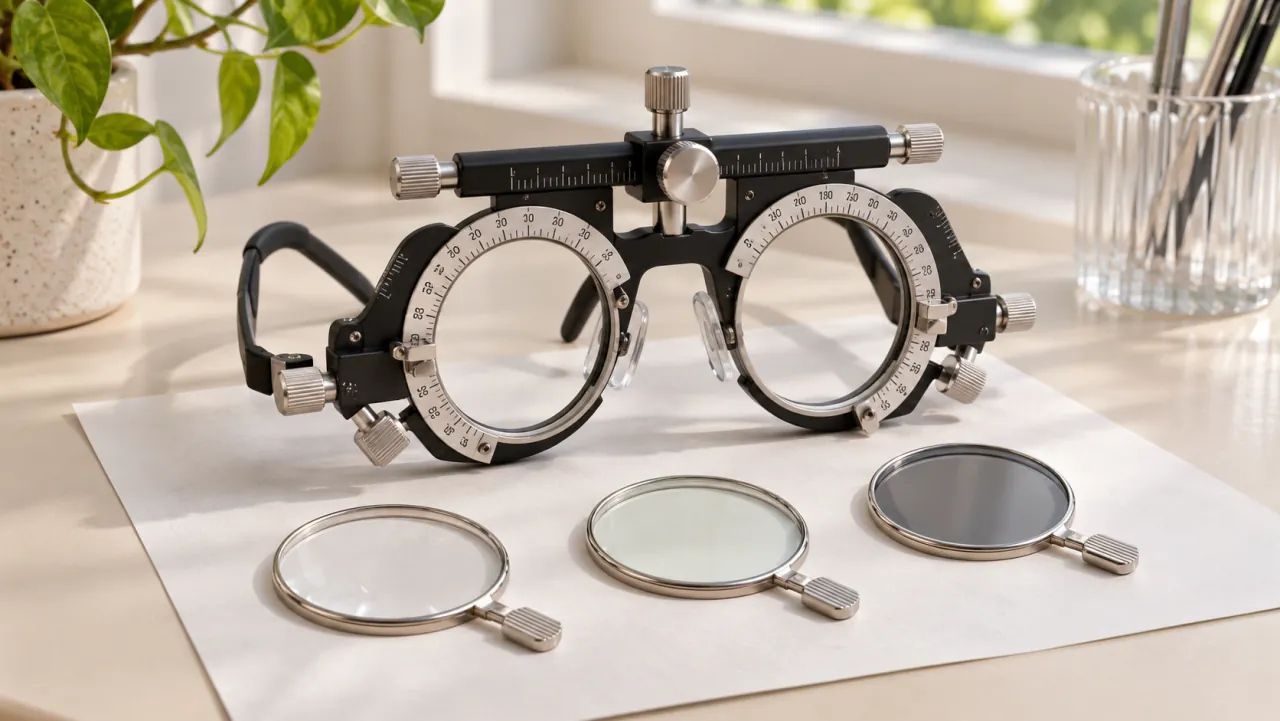
A glasses prescription is a compact set of instructions. To the person making the lenses, its signs, abbreviations and numbers carry precise meaning. To the person who will wear them, the same document can look like a scorecard with no explanation of what counts as good or bad.
It is more useful to think of the prescription as one part of an eyewear plan. It describes the optical correction prescribed for each eye, but it does not tell you everything about eye health, frame comfort, lens thickness, working distance or how well two eyes cooperate. Two people with similar numbers may need very different conversations about their glasses.
For anyone reviewing an eye prescription in North York, understanding the main fields can make those conversations easier. You do not need to calculate a new prescription yourself. You need to know what the existing one says, what it leaves out, and when a question belongs with the prescriber or dispensing professional.
Start with the eye, then the sign
The right eye is commonly labelled OD, and the left OS. Some prescriptions simply use R and L. Always check the labels rather than assuming the first number belongs to the eye on the same side of the page as you are looking at it.
The sphere, often abbreviated SPH, describes a lens power measured in dioptres. A minus value commonly corrects myopia, or nearsightedness. A plus value commonly corrects hyperopia, or farsightedness. These labels are useful starting points, but they should not be taken to mean that every farsighted person sees perfectly at distance or that every nearsighted person reads comfortably without glasses.
The National Eye Institute’s overview of refractive errors explains the underlying issue: the eye does not focus incoming light on the retina as intended. Glasses alter that focus. The numbers specify an optical correction, rather than measuring how hard someone has tried to look after their eyes.
A stronger number is not an eye-health grade
A prescription farther from zero generally indicates more lens power in that field. It does not, on its own, describe the health of the retina, optic nerve, cornea or lens inside the eye. Someone with a modest prescription can have an eye condition; someone with a stronger prescription may see very well with appropriate correction.
Avoid comparing prescription strength as though it were a percentage of sight remaining. A value such as minus four does not mean that four units of vision have been lost, and it cannot be converted into a meaningful percentage of blindness. Visual acuity, visual field, contrast and other functions are assessed differently.
This is one reason a prescription update and an eye-health assessment are related but distinct parts of care. If the numbers are unchanged but you have new glare, distortion or difficulty seeing, the unchanged prescription should not end the investigation.
Cylinder and axis work together
Cylinder, often written CYL, describes the amount of astigmatism correction. Axis specifies its orientation in degrees. These two fields belong together: a cylinder value without the appropriate axis does not provide complete instructions for making that part of the lens.
Astigmatism occurs when the eye’s focusing power differs across different directions. It is common and may coexist with myopia or hyperopia. The American Academy of Ophthalmology explains astigmatism, including why its correction is described differently from a simple spherical power.
The axis number is an angle, not a measure of severity. An axis of 180 is not inherently worse than an axis of 20. A change in orientation may still be relevant to how new glasses feel, especially when the cylinder correction is stronger, but its meaning depends on the whole prescription.
Why two prescriptions can look different yet be equivalent
Astigmatism prescriptions can be recorded in plus-cylinder or minus-cylinder notation. Converting between the two changes the written sphere, cylinder sign and axis while preserving the optical correction. Looking only at the sphere line can therefore create the impression of a substantial change that has not actually occurred.
If two records appear inconsistent, ask the prescriber or dispensing professional to compare them. Do not combine the sphere from one document with the cylinder from another, or assume a sign must be a typing mistake. A missing minus sign is consequential, but so is changing a legitimate sign without understanding the notation.
The same caution applies to an unclear photograph or handwritten copy. Obtain a legible version before ordering eyewear. Guessing the last digit or deciding which column a number belongs in is an avoidable source of error.
ADD describes extra near power
An ADD value is additional plus power used for near vision in relevant lens designs. It is often encountered as the eye’s natural ability to focus up close changes with age, a process called presbyopia. Bifocals and progressive lenses incorporate near support differently, while a separate reading pair may be prescribed for one working distance.
The ADD number is not necessarily the power printed on a pair of ready-made reading glasses that would suit you. Your distance correction, astigmatism, differences between eyes and intended reading distance all matter. Buying a reader that matches ADD alone can overlook those details.
Tell the clinician what “near” means for you. A book held close, a sewing project, a tablet on a stand and sheet music farther away place different demands on focus. The useful question is whether the prescribed lens supports the task comfortably, not whether a particular number seems typical for your age.
Prism has a direction as well as a strength
Some prescriptions include prism, together with a base direction. Prism changes the direction in which light enters the eye and may be prescribed to help selected binocular-vision problems. Its purpose differs from the focusing correction described by sphere and cylinder.
The American Academy of Ophthalmology’s guide to reading a prescription outlines the common fields, including prism and ADD. If prism appears on your prescription, ask what problem it is intended to address and what follow-up is expected.
Do not add prism to an order because a friend found it helpful, or omit it to simplify a purchase. New double vision also deserves assessment rather than a self-directed search for stronger glasses. Sudden double vision, particularly with headache, weakness, speech difficulty or other neurological symptoms, can need urgent medical evaluation.
The prescription does not contain every fitting measurement
Pupillary distance helps position the lenses horizontally in relation to the eyes. Fitting heights describe vertical placement relevant to the chosen design. Additional measurements may be needed for particular prescriptions, frame shapes or individualized lenses.
These measurements are not interchangeable with the optical power. A lens can contain the correct sphere and cylinder yet provide an uncomfortable view if the intended viewing areas are poorly positioned. Progressive lenses make this especially easy to notice because different areas serve different distances.
Measurements should reflect how the selected frame actually sits. If a frame is slipping, twisted or perched unusually high during measurement, later adjustment may change the relationship between your eyes and the lenses. Stable fit and accurate measurements belong in the same conversation.
Frame choice can change the experience
A prescription does not automatically make every frame equally suitable. Lens size and shape influence thickness, and the frame’s position relative to your face affects how you look through the lens. A very large fashion frame and a smaller everyday frame can produce different results from the same written powers.
Consider your practical priorities before settling on a style. You may care most about weight, a broad reading area, compatibility with a headset, or a frame that stays stable during a long shift. A comfortable bridge and appropriate width usually matter more in daily wear than a numerical frame size viewed in isolation.
You can explore eyewear options while keeping the prescription in context. Ask how the chosen frame will affect the finished lens and whether an alternative shape would make the result thinner, more stable or better suited to the intended task.
Glasses and contact lenses require different orders
Contact lenses sit directly on the eye; spectacle lenses sit in front of it. Contact-lens prescribing also involves the lens design, dimensions, material or brand, and assessment of how it fits and behaves on the eye. Copying the glasses numbers into an online contact-lens order does not supply that information.
The numerical powers may differ too, particularly at stronger prescriptions. Astigmatism correction available in a contact-lens design may use different steps from a spectacle order. These are clinical and fitting decisions, not signs that one prescription must be inaccurate.
Bring the packaging of your current contacts to a review. It allows the clinician to distinguish the lens you are actually wearing from an old prescription you may have saved. If comfort or vision varies through the day, explain the timing as well as the lens details.
Compare changes with symptoms, not just numbers
When you receive a new prescription, ask what changed and why the change is expected to help. A small adjustment can be useful for a demanding task. A larger measured difference may require a more careful discussion about adaptation, previous wear and the overall plan.
Tell the clinician if blur fluctuates, clears after blinking, affects one eye more, or began suddenly. Those details can direct attention beyond refraction. A prescription cannot explain every visual symptom, and repeating lens choices indefinitely is not a substitute for assessing the eye itself.
If a new pair is uncomfortable, return with both old and new glasses. The order, manufactured lenses, measurements, frame position and prescription can be checked together. Recording the exact problem, such as needing to lift the chin to read a monitor, is more helpful than assuming the entire prescription is wrong.
Keep a useful record and ask plain questions
Store a readable copy of your current prescription with its date and the name of the prescriber. Label older copies so they are not accidentally used for a new order. Keep contact-lens information separately, since similar-looking numbers can otherwise become mixed up.
Before ordering, confirm what the glasses are for, which lens design is intended, and who to contact if the result is uncomfortable. Ask for clarification of unfamiliar abbreviations. You should not need to become an optician to understand whether a pair is suitable for driving, desk work or close reading.
For a prescription review in North York, bring the glasses you use and describe the tasks that matter. A comprehensive eye examination connects the optical numbers with your vision and eye health. When you book a visit, the most productive starting point is often a simple observation about daily life rather than a concern about how large a number looks on paper.