

Eye Care Resources
Night Driving Problems in North York: Why Glare and Halos Feel Worse
February 26, 2026
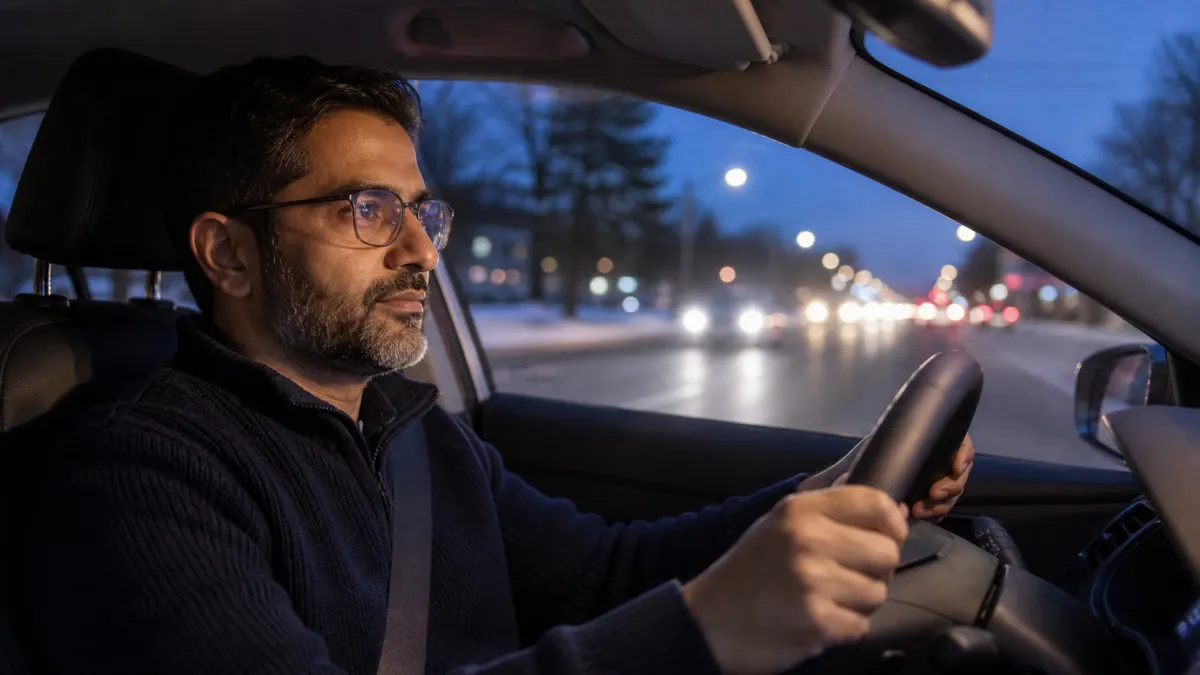
Night driving asks more of your eyes than the same route in daylight. Road markings have less contrast, pedestrians can blend into the background, mirrors and wet pavement reflect light, and bright headlights may sit directly beside areas you are trying to see. A person who feels confident behind the wheel at noon may feel tense, tired, or uncertain after sunset.
Some difficulty in low light is expected because the visual system is working with less information. However, growing glare, halos, blur, or trouble recovering after an oncoming vehicle passes should not simply be accepted as part of getting older. These symptoms can appear when your prescription has changed, your lenses or windshield scatter light, your eyes are dry, or an eye condition is affecting contrast and clarity.
For drivers experiencing night-driving problems in North York, a comprehensive eye exam can identify correctable causes and check for concerns that need monitoring or treatment. The goal is not just to read a small line in a bright examination room. It is to understand how well your vision supports the real demands of dark streets, traffic, changing weather, and headlight glare.
Why seeing at night is different
In daylight, the eye has abundant light and can distinguish fine detail and colour efficiently. At night, the visual system becomes more dependent on cells that are sensitive to low light but less suited to sharp detail and colour discrimination. Contrast falls, so a dark object against a dark road can be difficult to detect even when you can read a standard eye chart well.
The pupil also becomes larger in dim conditions to let in more light. A larger pupil exposes more of the eye’s optical system. Small focusing errors and optical imperfections that are barely noticeable during the day may create more blur, flare, or ghosting at night.
Bright headlights introduce another challenge. The visual system must handle intense light while still detecting dim information around it. Glare can be uncomfortable, but it can also reduce the visibility of low-contrast objects near the light source. Recovery may feel slower after a bright vehicle passes, particularly when the eyes, prescription, or natural lenses have changed.
Signs that night vision deserves attention
Drivers describe night-vision problems in different ways. You may notice:
- starbursts or rings around headlights and streetlights;
- blurred road signs that become clearer only when you are very close;
- difficulty seeing lane markings, curbs, cyclists, or pedestrians;
- a long recovery period after oncoming glare;
- squinting or leaning forward to see the road;
- double or ghost images around lights;
- reduced confidence in rain, snow, or unfamiliar areas;
- headaches or tired eyes after evening driving; or
- avoiding night driving even on routes that used to feel easy.
The pattern matters. A gradual change in both eyes may suggest a different cause from a sudden disturbance in one eye. Halos accompanied by significant eye pain, redness, headache, nausea, or abrupt blur need prompt assessment. New double vision, a shadow in the visual field, or a sudden burst of flashes and floaters should also be treated as urgent rather than as ordinary glare.
An outdated prescription can hide in daylight
A small amount of nearsightedness or astigmatism may have a bigger effect at night than during the day. Nearsightedness softens distant signs and road details. Astigmatism can stretch or duplicate points of light, creating streaks, flares, or ghost images. When pupils enlarge in the dark, these effects may become more apparent.
Some people develop a small shift toward nearsightedness in low light. Others have enough focusing reserve to compensate in bright conditions but not during a long evening drive. An old prescription may still seem acceptable around the house while failing on a dark road.
Refraction during an eye exam determines whether an updated lens improves distance clarity. Your optometrist can also compare each eye, evaluate how the eyes work together, and check whether the symptoms can be fully explained by prescription. If lenses do not restore the expected quality of vision, the health examination becomes especially important.
Do not borrow another person’s glasses or order a stronger distance prescription based only on how headlights look. Too much or incorrect correction can create new blur and discomfort. Night-driving glasses should be based on accurate measurements and an up-to-date exam.
Lens reflections and anti-reflective coatings
Every untreated eyeglass lens reflects some light from its surfaces. At night, reflections from headlights, streetlights, and the dashboard may appear as distracting secondary images. Scratches, worn coatings, fingerprints, and smudges scatter additional light.
A quality anti-reflective coating can reduce surface reflections and allow a clearer view through the lens. It does not eliminate glare produced inside the eye, cure cataracts, or compensate for an inaccurate prescription. The lens still needs to be clean, correctly centred, and suitable for the wearer.
Inspect your glasses under good light. A cloudy film that does not clean away, clusters of fine scratches, or a damaged coating may contribute to poor night quality. Clean lenses with a method recommended for the coating rather than dry-wiping grit across the surface. If the frame is crooked or slides down, have it adjusted so you look through the intended optical area.
For progressive lenses, the distance zone must be positioned correctly. Looking through the intermediate or outer portion of the lens can reduce clarity. If night driving changed after receiving new progressives, return for a fit, measurement, and prescription review instead of assuming you simply need months to adapt.
Why yellow or tinted “night-driving” lenses can be misleading
Yellow and amber lenses are often advertised as a solution for headlight glare. They may make a scene look warmer or seem subjectively brighter because of the colour shift, but a tint reduces the total amount of light reaching the eye. At night, when light is already limited, that reduction can make dim objects and low-contrast hazards harder to see.
Sunglasses and dark photochromic lenses should not be worn for night driving. Polarized sunglasses are useful for reflected glare in bright daytime conditions, but they also reduce light and are not a nighttime solution. A clear lens with the correct prescription and a suitable anti-reflective coating is generally a more sensible starting point.
Marketing language such as “glare blocking” does not prove that a lens improves safe visual performance. Ask what the lens actually does, how much visible light it transmits, and whether it is intended for legal nighttime driving. Comfort and safety are not always the same outcome.
Dry eye can make lights spread and vision fluctuate
The tear film creates the first smooth optical surface at the front of the eye. When it breaks up, points of light may flare, clarity may fluctuate, and your vision may sharpen briefly after a complete blink. Car heating and air conditioning can direct dry air toward the face, while concentrated driving can reduce blink frequency.
Contact lens wearers may notice late-day dryness, lens deposits, movement, or rotation that affects clarity. Astigmatism-correcting contacts can produce changing blur if they do not remain in the intended orientation. A lens that was comfortable in the morning may not provide reliable night vision after many hours of wear.
If blinking temporarily clears the image, mention that pattern during your exam. Your optometrist can assess the eyelids, tear film, cornea, blink, and contact lens fit. Management may involve environmental changes, appropriate lubricating drops, eyelid care, a modified wearing schedule, or a different lens design.
Pain, marked redness, light sensitivity, discharge, or sudden blur in a contact lens wearer requires prompt attention. Remove the lenses with clean hands and call an eye care professional rather than driving while the vision is compromised.
Cataracts and headlight glare
A cataract is clouding within the natural lens of the eye. As the lens becomes less transparent, light can scatter rather than forming a clean image on the retina. Early symptoms may include increased headlight glare, halos, faded colours, reduced contrast, cloudy vision, and difficulty seeing at night.
Someone with an early cataract may still read a bright high-contrast chart reasonably well but struggle in real-world low-contrast conditions. A prescription update can sometimes improve vision during an early stage. When cataracts interfere with important activities such as driving, a referral for surgical assessment may be appropriate.
Not every halo is caused by cataract, and not every cataract requires immediate surgery. A dilated eye examination helps evaluate the natural lens and ensures that the retina, macula, optic nerve, and other structures are also considered. The decision about surgery is based on the examination, the person’s needs, and how much the cataract affects daily life.
Changes in contrast sensitivity with age
Visual acuity—the ability to resolve small high-contrast detail—is only one part of useful driving vision. Contrast sensitivity describes how well you can detect objects that do not stand out clearly from their background. A grey-clothed pedestrian on a dark street is a contrast task, not the same task as reading black letters on a white chart.
Contrast performance can decline with normal ageing and may be further affected by cataract, corneal problems, retinal disease, glaucoma, or other conditions. Dark adaptation and recovery from glare may also become slower. These changes help explain why a person can pass a familiar daytime vision check yet remain uncomfortable at night.
Tell your optometrist about the situations that are difficult, not only whether your distance vision is “fine.” A symptom-driven examination can consider contrast, pupil responses, eye health, and functional needs in addition to standard acuity.
Other eye-health causes to rule out
Night-vision difficulty is not specific to one condition. Corneal irregularity, complications after eye surgery, retinal disease, optic nerve disease, high prescriptions, poorly controlled blood sugar, medication effects, and binocular-vision problems can all affect visual quality.
People who have had laser vision correction should mention new or persistent glare, halos, dryness, or night blur. These symptoms require an individualized assessment of prescription, corneal shape, tear film, and surgical history. Do not assume that because distance vision was excellent after surgery, every later night symptom is unrelated to the eyes.
Diabetes can affect vision through changing focus or retinal complications. Some retinal conditions reduce night vision or peripheral awareness before central reading detail is severely affected. Regular eye-health examinations are important even when a new pair of glasses seems to help.
The windshield is part of the optical system
Light passes through the windshield before it reaches your eyes. Dirt, road film, salt residue, fine scratches, fog, and streaks can scatter oncoming light. Clean both the outside and inside surfaces, since an interior film can be almost invisible during the day but obvious against headlights.
Maintain effective wiper blades and washer fluid appropriate for the season. Clear snow and ice fully rather than creating a small viewing opening. Repair damage that interferes with the driver’s field of view according to professional vehicle guidance.
Keep the dashboard only as bright as needed to read it comfortably, and avoid unnecessary interior lights. A very bright display can make it harder for the eyes to remain adapted to the darker road. Set mirrors properly and use the rear-view mirror’s night setting when available and appropriate.
These vehicle changes cannot treat an eye problem, but they remove avoidable sources of scatter and distraction. If two drivers use the same clean car and only one experiences severe glare, that difference is another reason to arrange an eye exam.
Rain, snow, and North York streets
Wet pavement reflects headlights and streetlights, producing bright patterns across the road. Rain on the windshield adds more optical surfaces, while snow can hide lane markings and create high contrast between bright banks and dark roadway. Winter salt quickly coats both glass and headlamps.
Poor weather also increases stopping distance and reduces the time available to respond. Visual discomfort should be treated as a safety issue rather than a challenge to push through. Slow down for conditions, increase following distance, and choose a safe place to stop if you cannot see well enough to continue.
Use vehicle lights correctly and make sure they are clean and functioning. Do not rely on daytime running lights as a substitute for the full lighting needed in darkness or poor weather. Driver-assistance displays may provide information, but they do not replace direct attention to the road and can become another source of glare or distraction.
Practical steps before your next evening drive
Several simple checks can reduce avoidable blur and glare:
- Wear your current distance prescription rather than an older backup pair.
- Clean both sides of your eyeglass lenses and the inside and outside of the windshield.
- Avoid sunglasses, yellow tints, or other light-reducing lenses at night.
- Keep car vents from blowing directly into your eyes.
- Use appropriate lubricating drops if your optometrist has recommended them.
- Dim dashboard and interior lighting to a comfortable, readable level.
- Plan a familiar, well-lit route when possible.
- Do not drive when you are too tired, visually uncertain, or impaired by medication.
- Allow extra time and distance in rain, snow, or ice.
If glare remains significant after the obvious surfaces are clean, do not keep experimenting with retail lens products. A change in night confidence can be an early sign that your prescription or eye health needs attention.
What an eye exam for night-driving problems includes
The appointment begins with the details of your experience: when the change began, whether it affects one eye or both, which conditions are hardest, and whether glasses, blinking, or time of day changes the symptom. Bring the glasses and contact lenses you use for driving.
Your optometrist may measure distance vision and refraction, compare the two eyes, assess pupils and eye coordination, inspect the tear film and cornea, measure eye pressure, and examine the natural lens, retina, macula, and optic nerve. Dilation or additional imaging may be recommended according to your symptoms, age, and health history.
The result may be a prescription update, an anti-reflective lens recommendation, dry-eye management, contact lens changes, monitoring, or referral. Sometimes the eyes are healthy and the prescription is accurate; that finding is still useful because it directs attention to vehicle, environmental, medication, or medical factors.
When to stop driving and seek care
Do not continue driving if you cannot reliably see lane markings, signs, people, vehicles, or obstacles. Arrange another way home and seek guidance. No lens coating can make unsafe vision acceptable for one more trip.
Contact an eye care professional promptly for a sudden change in night vision, new blur in one eye, sudden double vision, significant eye pain or redness, or halos with headache and nausea. New flashes, many floaters, a curtain or shadow, or any abrupt loss of sight also require urgent assessment. Call emergency services when visual symptoms occur with weakness, facial droop, confusion, difficulty speaking, or another possible neurological emergency.
Gradual symptoms deserve an appointment too. Reducing or avoiding night driving until you understand the cause is a responsible choice, not an overreaction.
Night-driving eye care in North York
Night driving combines low contrast, limited light, glare, motion, and quick decision-making. Small optical problems that hide during the day can become obvious after sunset. The good news is that many contributors—an outdated prescription, damaged lenses, dry eye, or an unsuitable contact lens—can be addressed once they are identified.
Optima Eye Care provides comprehensive eye exams, prescription updates, dry-eye assessment, contact lens care, and cataract monitoring for drivers in North York. We can explain whether your symptoms come from the correction in front of your eyes, the surfaces of your eyes, the structures inside them, or a combination of factors.
If headlights have become overwhelming, road markings disappear in rain, or you no longer trust your vision after dark, request an appointment. Clearer night vision starts with an accurate diagnosis—not a darker tint, a stronger pair of borrowed glasses, or another season of avoiding the question.