

Eye Care Resources
Laser Eye Surgery Consultations in North York: Questions to Ask Before a Referral
April 16, 2026
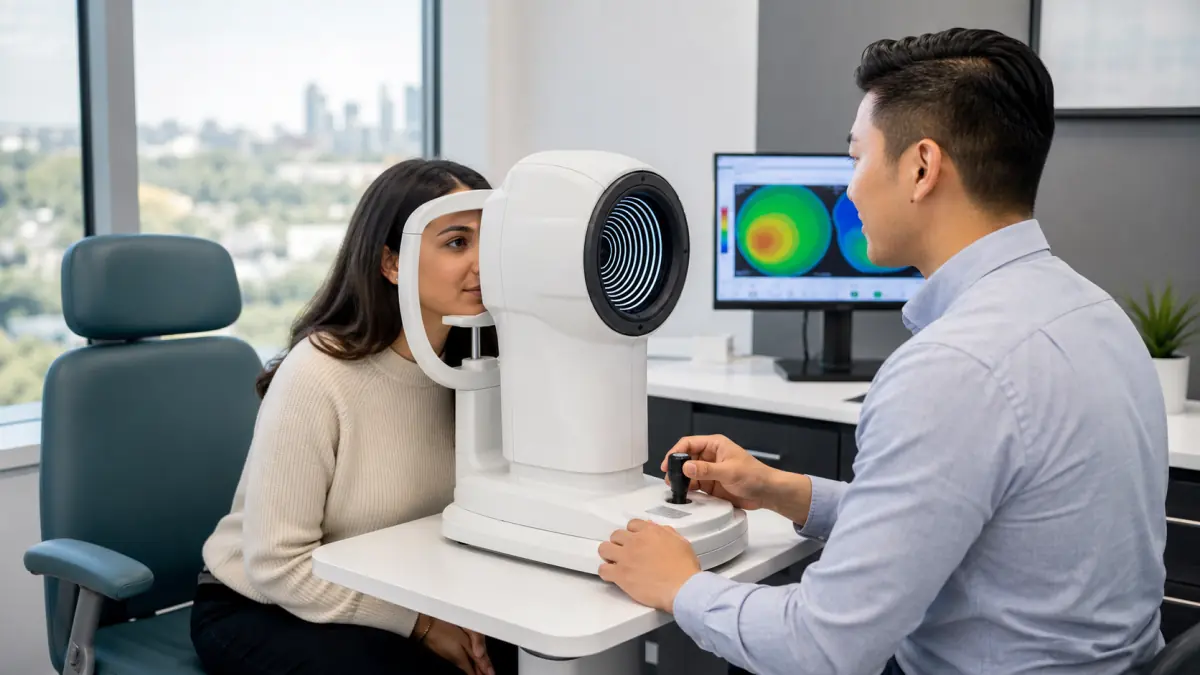
Laser vision correction is often introduced with a simple promise: less dependence on glasses or contact lenses. The actual decision is more personal and more complex. Your prescription, corneal shape, tear film, age, health, occupation, sports, night-driving needs, and expectations all affect whether surgery is suitable and which procedure a surgeon may recommend.
A consultation is therefore not a commitment to have surgery. It is a structured way to learn what your eyes may qualify for, what benefits are realistic, what risks matter in your circumstances, and what alternatives remain available. A thoughtful consultation can also conclude that waiting, treating dry eye, updating eyewear, or avoiding refractive surgery is the better choice.
Optima Eye Care offers laser surgery consultations for North York patients considering referral. The optometrist can review vision and eye health, discuss goals, identify findings that need attention, and help you prepare for a procedure-specific evaluation by the ophthalmic surgeon who would perform the operation.
What does laser eye surgery change?
Common corneal laser procedures reshape the clear front surface of the eye so light focuses more accurately on the retina. They are used to reduce refractive errors such as nearsightedness, farsightedness, and astigmatism. LASIK and PRK are two familiar examples, but surgical centres may offer other techniques depending on available technology and patient suitability.
The procedures do not stop the eye from aging. They do not prevent cataracts, glaucoma, macular degeneration, retinal disease, or future prescription change. They also do not guarantee that a person will never need glasses again.
That distinction is fundamental. The goal is usually to reduce dependence on correction for selected distances—not to make the eyes permanently perfect or protected from future eye conditions.
What is the role of the pre-referral consultation?
An optometric consultation can establish whether a referral is reasonable and what questions should travel with it. It may include a comprehensive eye examination, refraction, eye-health assessment, tear-film evaluation, and review of prescription stability, contact lens use, medical history, medication, and lifestyle.
Depending on the clinic and findings, additional corneal measurements or imaging may be available. The surgeon’s centre performs the definitive candidacy testing and selects or declines a procedure. Only the operating surgeon can provide procedure-specific informed consent and explain how their equipment, technique, and experience apply to your case.
This division of roles is worth clarifying before referral. Ask who performs each part of the pre-operative assessment, who makes the final surgical decision, and who will provide each post-operative visit.
Question 1: What result am I actually hoping for?
“I want to see without glasses” is a starting point, not a complete goal. Consider when independence matters most. Is it waking up and seeing the clock, swimming, playing sports, travelling, working in protective equipment, or driving? Do you need fine night vision for your occupation? Are you comfortable using reading glasses later?
Your preferred result may involve tradeoffs between far, intermediate, and near vision. A person who values crisp binocular distance vision may make a different choice from someone prioritizing phone use without readers. Explain which activities would make surgery worthwhile and which visual compromises would be unacceptable.
Ask:
- What level of unaided vision is realistic for my prescription?
- Is the goal reduced dependence or complete freedom from glasses?
- What tasks may still require glasses afterward?
- How likely is residual prescription in eyes like mine?
- What does a successful outcome mean at this clinic?
Be cautious with guarantees. Even carefully screened patients can heal differently, and excellent chart acuity does not describe every aspect of visual quality.
Question 2: Has my prescription been stable long enough?
Laser treatment is based on the refractive error measured before surgery. If the prescription is still changing, a technically accurate procedure can be followed by new blur as the eye continues to change.
Bring previous prescriptions if possible. Ask what the surgical centre considers stable and whether your records meet that standard. Age alone does not prove stability. Younger adults may still be progressing, while pregnancy, nursing, diabetes, medication changes, or other factors can make measurements fluctuate.
If the current refraction differs from the old one, the sensible response may be to repeat measurements after an interval rather than rush toward a date. Delaying surgery to establish a trustworthy baseline is part of risk reduction.
Question 3: Are my corneas suitable?
Refractive laser surgery changes corneal shape and removes or separates tissue depending on the procedure. The surgeon needs to understand thickness, curvature, symmetry, and structural stability before recommending treatment.
Corneal topography or tomography maps the front surface and, with some systems, deeper shape information. Pachymetry measures thickness. These tests help screen for irregular patterns, keratoconus, prior injury, scarring, or other findings that may increase risk.
Useful questions include:
- What do my corneal maps show?
- Is the thickness appropriate for the amount of correction planned?
- Is there any irregularity or sign of structural weakness?
- How much tissue would the proposed treatment leave?
- Does my corneal shape favour one procedure over another?
- Would surgery increase my risk of ectasia?
Do not interpret a colourful map by yourself. Its meaning depends on the device, scan quality, prescription, corneal thickness, and the surgeon’s analysis.
Question 4: Does dry eye change my candidacy?
Dry eye can affect both measurement accuracy and comfort after refractive surgery. An unstable tear film can make vision fluctuate and can interfere with reliable corneal testing. LASIK can cause or worsen dry-eye symptoms, sometimes for a prolonged period.
Tell the optometrist and surgeon about burning, grittiness, watering, fluctuating blur, contact-lens intolerance, eyelid inflammation, previous treatment, and use of artificial tears. Symptoms that seem mild during an ordinary day may become important when surgery is considered.
Ask whether the ocular surface should be treated before repeating measurements. Management may involve changes in lens wear, lubricants, eyelid care, environmental measures, or prescription treatment based on the diagnosis. A delay to stabilize the surface can improve the quality of the candidacy assessment.
Optima Eye Care can assess symptoms through its dry eye service when eye-surface comfort is part of the surgical conversation.
Question 5: Which procedure is being recommended—and why?
Procedure names are not interchangeable marketing tiers. LASIK creates a corneal flap before reshaping underlying tissue. PRK reshapes the cornea after removing the surface epithelium, which then regrows. Other approaches may use different incisions, lasers, or implanted lenses.
Each option has its own candidacy requirements, recovery pattern, discomfort, advantages, limitations, and risks. A faster early recovery does not automatically make one procedure best for every cornea or lifestyle.
Ask the surgeon:
- Why do you recommend this procedure for my eyes?
- Why are the alternatives less suitable?
- Does the procedure involve a flap?
- How do my prescription and corneal measurements affect the choice?
- What is the expected discomfort and visual recovery?
- Does my sport, occupation, or risk of facial impact change the recommendation?
- Is an implant-based option relevant if corneal laser surgery is unsuitable?
A clear answer should connect the procedure to your findings rather than rely only on a branded technology name.
Question 6: How will presbyopia affect the result?
Presbyopia is the age-related decline in near focusing ability that commonly becomes noticeable in the 40s. Standard distance correction does not stop it. Someone who sees both far and near without glasses because they are mildly nearsighted may lose that unaided near advantage when both eyes are corrected for distance.
Ask what near vision is likely to be immediately and over time. Reading glasses may still be needed even if distance surgery is successful.
Monovision is one strategy in which one eye is targeted more for distance and the other for near. It can reduce dependence on readers for selected patients, but it may affect depth perception, contrast, or visual balance. A contact-lens simulation before permanent surgery can help some people experience the concept, though a trial cannot reproduce every aspect of a surgical result.
Questions to ask include:
- If both eyes are corrected for distance, when might I need reading glasses?
- Am I already relying on my nearsightedness to read?
- Is monovision appropriate for my work and driving needs?
- Can I trial monovision before deciding?
- What happens as presbyopia continues to progress?
Question 7: What are the night-vision and contrast risks?
Seeing 20/20 letters in a bright exam room is not the same as seeing comfortably on a rainy North York road at night. Glare, halos, starbursts, ghost images, and reduced contrast can occur after refractive surgery. Some symptoms improve during healing; others can persist.
Discuss your baseline night vision, pupil size in dim conditions, prescription, and occupational driving. If you already have halos from dry eye, contact lenses, or another condition, document that before surgery so expectations are grounded in your actual starting point.
Ask the surgeon how often patients with profiles similar to yours report troublesome night symptoms, how the treatment zone relates to your measurements, and what management options exist if quality of vision is not acceptable.
Question 8: What complications should I understand?
All surgery carries risk. The list and probability depend on the procedure, device, surgeon, prescription, cornea, and patient health. Potential concerns discussed for corneal refractive surgery can include dry eye, undercorrection or overcorrection, regression, glare and halos, infection, inflammation, corneal haze, flap complications with LASIK, structural weakening or ectasia, and loss of best-corrected visual quality.
Rare does not mean impossible, and a long list without context is difficult to use. Ask for both the nature and likelihood of complications in patients comparable to you. Ask which problems are temporary, which may require prolonged medication or another procedure, and which can permanently affect vision.
Read the informed-consent document before the day of surgery if possible. Make notes and request answers in plain language. Consent is not merely a signature; it is evidence that benefits, alternatives, limitations, and material risks have been discussed.
Question 9: What is the surgeon’s experience with this exact procedure?
Experience should be relevant to the procedure and technology proposed, not only a broad number of years in practice.
Consider asking:
- How many eyes have you treated with this procedure and platform?
- How often do you treat prescriptions and corneas similar to mine?
- What outcomes do you track?
- What are your enhancement and complication rates for comparable patients?
- Who handles an urgent problem after hours?
- Will I meet the operating surgeon before the day of surgery?
No statistic can guarantee an individual outcome. The purpose is to understand the surgeon’s experience, transparency, and follow-up system—not to shop for the most impressive isolated percentage.
Question 10: Who provides follow-up care?
Post-operative care is part of the procedure, not an optional extra. Some surgical centres provide every visit. Others coordinate certain checks with the referring optometrist. Either model can work when responsibilities, communication, records, and urgent access are clear.
Ask:
- Who examines me the day after surgery and at later visits?
- Which appointments take place at the surgical centre?
- Which appointments may occur with my North York optometrist?
- How are findings shared between providers?
- Whom do I call at night or on a weekend?
- What symptoms require same-day assessment?
- Are post-operative visits included in the quoted fee?
Obtain written instructions and save every contact number before surgery. Severe or increasing pain, worsening redness, discharge, trauma, or a sudden decline in vision should be reported according to the surgeon’s urgent-care instructions rather than watched at home.
Question 11: What will recovery require from my real life?
Recovery varies by procedure and patient. Ask about the likely course of blur, light sensitivity, discomfort, drops, protective shields, screen use, exercise, swimming, eye makeup, dusty work, and driving. Do not rely on a friend’s timeline.
Arrange transportation for surgery and any early visit when driving is restricted. Plan work leave based on your visual demands, not only whether you can open your eyes. A desk worker, night driver, health professional, and construction worker may need different recovery margins.
Contact lenses must usually be stopped before definitive measurements because they can alter corneal shape. The required interval varies with lens type, wearing history, and surgeon protocol. Follow the surgical centre’s exact instructions rather than choosing a generic number from the internet.
Question 12: What happens if the result is not the target?
Some eyes retain a residual prescription or change after initially good vision. Ask how the centre defines an enhancement, when it can be considered, what stability and corneal criteria apply, and whether there are extra costs.
An enhancement is another surgical decision, not an automatic touch-up. The surgeon must reassess healing, measurements, symptoms, and available corneal tissue. Glasses or contact lenses may be safer or more practical in some situations.
Clarify what is included in any advertised “lifetime” or “guarantee” language. Ask about eligibility, exclusions, required annual exams, time limits, and which fees remain. Medical outcomes cannot be guaranteed, even when a commercial policy covers selected retreatments.
Question 13: Are there career, sport, or future-eye-care implications?
Some occupations have specific unaided and corrected vision standards or policies about refractive surgery. Pilots, police applicants, military personnel, commercial drivers, and others should verify current requirements with the relevant employer or regulator before proceeding.
Sports involving facial impact may influence the discussion of flap-based versus surface procedures. Pregnancy plans, autoimmune disease, diabetes, healing disorders, previous herpes eye disease, glaucoma, cataract, retinal risk, and medications can also matter.
Tell every future eye-care provider about refractive surgery. Corneal reshaping can influence certain measurements used later in life, including calculations for cataract surgery and interpretation of eye pressure. Keep copies of the pre-operative prescription, corneal measurements, operative report, and follow-up records. Health Canada specifically advises retaining the pre-operative report for future reference.
What should you bring to the consultation?
Bring your current glasses, previous prescriptions if available, contact-lens details, and a complete medication and supplement list. Include past eye infections, injuries, surgeries, dry-eye treatment, medical conditions, allergies, and family eye history.
Write down your work, driving, sports, reading, and screen priorities. Note what you like and dislike about current glasses or contacts. If night vision is already difficult, say so before any procedure is discussed.
Bring a written question list and consider having a trusted person join the conversation. There is no need to decide on the spot. A responsible process leaves room to read the consent materials, compare options, and ask follow-up questions without pressure.
When might waiting be the right answer?
Waiting may be recommended when the prescription is changing, the ocular surface is unstable, corneal measurements need confirmation, health or medication affects healing, pregnancy-related changes are possible, or expectations do not match a realistic result.
You may also decide that current glasses or contact lenses work well enough that the surgical benefits do not outweigh the cost and risk. That is a valid outcome. Elective refractive surgery should fit your priorities; it is not something you owe yourself simply because testing suggests you could qualify.
A “not now” decision can sometimes become “reconsider later” after dry eye treatment or documented stability. A finding that makes corneal surgery inappropriate may lead to discussion of other corrective options with the appropriate specialist.
Laser eye surgery consultations in North York
The quality of a laser eye surgery decision depends less on choosing the most advertised procedure and more on understanding your own starting point. Stable measurements, healthy corneas, a managed tear film, realistic expectations, informed consent, and a clear follow-up plan all matter.
Optima Eye Care can provide a comprehensive eye-health and vision assessment, discuss whether referral is reasonable, and help North York patients prepare focused questions for the operating surgeon. The surgery itself and final procedure selection are handled by the ophthalmic surgical team.
If you are considering reducing your dependence on glasses or contacts, request a laser surgery consultation. Bring your visual goals as well as your concerns. A good consultation should make the decision clearer—even when the best decision is to wait or choose a non-surgical alternative.