

Eye Care Resources
Contact Lens Care and Storage in North York: Building Safer Daily Habits
May 31, 2025
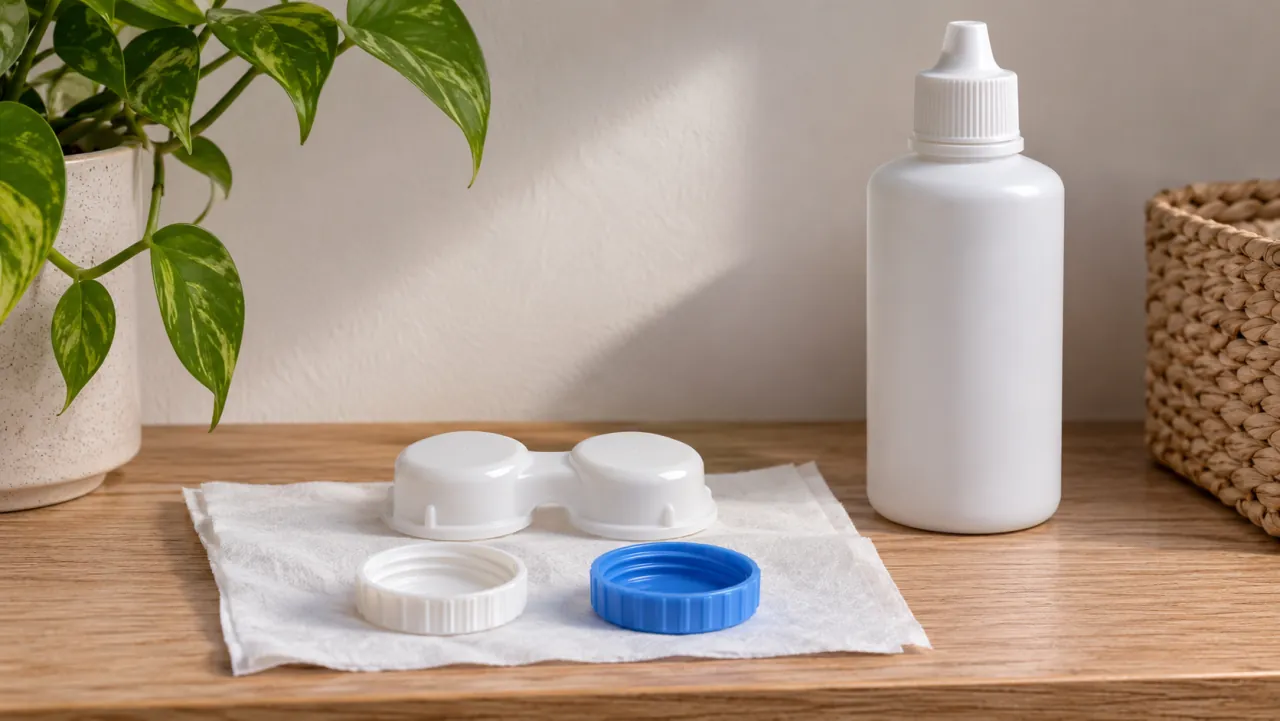
The weakest part of a contact lens routine is often an ordinary moment: a nearly empty solution bottle, a case left damp beside the sink, or an unexpected overnight stay. None of these situations seems dramatic. Each can encourage a shortcut when you are tired and simply want to remove your lenses.
Good care becomes easier when the correct supplies and decisions are already in place. For people wearing contact lenses in North York, that might mean keeping glasses in a work bag, checking supplies before a weekend trip, or arranging a clean storage area in a small shared bathroom.
Care instructions depend on the exact lens and disinfection system. This guide explains the underlying habits, but your product label and clinician’s instructions take priority for soaking times, replacement intervals, and compatibility. If those instructions are unclear, ask for clarification before using the product. Guessing is a poor substitute for a routine you understand.
Begin with the difference between cleaning and disinfecting
Cleaning helps remove deposits and debris from a reusable lens. Disinfection reduces microorganisms using a suitable lens-care system for the specified period. A quick rinse cannot substitute for the complete process.
This distinction explains why sterile saline is not a general replacement for disinfecting solution. Saline may have a specific role in a prescribed lens routine, but it does not automatically disinfect a stored lens. Rewetting drops are also intended for a different purpose. Do not choose a product solely because the label includes the words “contact lens.”
The CDC’s guide to cleaning, disinfecting, and storing lenses distinguishes the major care systems. Read the directions when starting a new bottle or switching packaging. An updated cap or label can be easy to overlook if you have handled similar products for years.
Set up a place where handling is straightforward
Choose a clean, well-lit surface where you can put supplies down without balancing them on a wet sink edge. Close the drain if you are handling lenses nearby. Keep pets, loose hair, cosmetics, and household cleaning products away from the working area.
Wash your hands with soap, rinse them thoroughly, and dry them completely using a clean cloth that does not leave lint. The goal is to avoid transferring dirt, moisture, or product residue to the lens. Hand sanitiser alone is not a substitute for the washing and drying routine you were taught.
If several people share the bathroom, give lens supplies their own storage space. A small dry tray or designated shelf can prevent a case from being moved among toothbrushes and splash-prone items. The arrangement does not need to be elaborate. It should make correct handling convenient enough to repeat when you are distracted.
Make the evening sequence predictable
For reusable lenses using a compatible multipurpose system, follow the label’s rubbing, rinsing, and soaking directions. Use fresh disinfecting solution each time. Do not add new solution to the liquid left over from a previous use.
Work on one lens at a time and keep a consistent right-left order if that helps prevent mix-ups. Before closing the case, confirm that each lens is fully in the correct compartment and that the case contains the appropriate amount of fresh solution. A lens caught along the rim can dry out or tear.
Disinfection needs the specified time. If you remove lenses for only a brief interval, do not assume the usual overnight process has already finished. Ask what to do when you need a short break from wear. The answer depends on the product; it should not be invented in the middle of a rushed day.
The storage case needs its own care
A case can look clean while still requiring attention. For conventional reusable lens cases, the CDC recommends cleaning with fresh solution, air-drying with the caps off, and replacement at least every three months. Follow any earlier replacement requirement for your particular system.
After removing the lenses, discard the old liquid. Clean the case as directed, then let it dry in a clean location. Do not keep a closed, wet case in a pocket throughout the day and assume it will be ready for the evening.
Peroxide systems have specialised cases, so their cleaning and replacement directions may differ. Use the instructions supplied with that system. A case should not become a permanent accessory simply because it still closes properly. Marking a replacement date on a calendar can help, particularly when your case is not packaged with every solution purchase.
Hydrogen peroxide is a separate system
Peroxide-based contact lens care can be useful for some wearers, but it requires an exact neutralisation process. Depending on the system, a special case, neutralising disc, or other designated component converts the peroxide into a form suitable for lens wear after the required interval.
Never place unneutralised peroxide in the eye or use it as a final rinse before inserting a lens. Never substitute an ordinary flat case for the designated case. The FDA explains these peroxide precautions, including the importance of using the full neutralisation process.
Keep peroxide away from lubricating drops so the bottles cannot be confused. If someone else helps with your care, make sure they understand the distinction too. If accidental exposure causes burning, remove the lens if you can do so readily, immediately rinse the eye with plenty of clean lukewarm water, and seek urgent advice. Emergency eye irrigation is different from routine lens care: never delay rinsing a chemical exposure because water is normally kept away from contacts.
Water does not belong in the storage routine
Tap water, bottled water, distilled water, and homemade saline are not substitutes for approved contact lens products. Avoid rinsing lenses or cases under the tap, and remove lenses before showering or swimming.
This rule becomes easier to follow if you decide what to do when solution runs out. Switch to glasses and obtain suitable supplies. Do not try to rescue a night of contact lens wear by storing the lenses in a drinking glass or reusing old liquid. A lens may need to be discarded rather than preserved at the expense of eye safety.
The same planning applies at a fitness centre or a friend’s home. A travel kit should contain the products you actually use, not an assortment of miniature bottles whose contents you cannot identify. For water-related activities, our swimming and contact lens guide discusses practical alternatives.
Replacement is based on instructions, not appearance
A reusable lens does not become safe to keep simply because it remains transparent. Deposits and changes to the surface are not always obvious when you look at it on your finger. Follow the replacement interval you were given, including how that interval is counted after opening.
A daily disposable is not intended to be cleaned and stored for another day. If you have both daily and reusable lenses for different purposes, keep the boxes separate and check which product you are using. Similar-looking lenses can have entirely different care requirements.
Record the opening date for reusable lenses somewhere you will actually check. A calendar reminder can be more reliable than trying to remember whether a pair was opened before or after a particular weekend. If the date is uncertain, ask for guidance rather than choosing the most convenient estimate.
Stored lenses are not forgotten lenses
People who wear contacts occasionally may leave reusable lenses in a case for an extended period. Disinfecting solution has instructions for storage duration, and lenses may need another complete cleaning and disinfection cycle before being worn again.
Read that part of the label instead of assuming a sealed case preserves lenses indefinitely. Check the solution’s expiry date and any discard-after-opening period. A bottle may reach its recommended disposal date even when plenty of liquid remains.
Avoid topping up an evaporating case, combining different solutions, or adding a new product to a case containing the old one. If the case has dried out or the condition of the lens is uncertain, do not insert it to test whether it still feels acceptable. Bring the question to your eye-care professional and use glasses meanwhile.
Pack for the moment your plans change
A useful contact lens kit is built around removal, not just insertion. Include current glasses, the appropriate case and solution for reusable lenses, and spare lenses if advised. Keep supplies in their original labelled packaging and avoid decanting solution into travel containers.
For a North York commute, the relevant problem may be getting home comfortably after a lens becomes irritating at work. For an overnight visit, it may be removing lenses before you fall asleep. For a flight, it may be remembering that a nap still counts as sleeping in lenses.
Review the kit periodically. Expired solution, an old case, or glasses that no longer provide usable vision can create a false sense of preparedness. It is more helpful to have a modest kit that works than a large collection of forgotten supplies at the bottom of a bag.
Do not clean your way through a painful red eye
If a lens wearer develops pain, marked redness, light sensitivity, discharge, or a new change in vision, the priority is an eye assessment. Remove the lenses and avoid putting them back in. Repeatedly cleaning the lens does not establish that the eye is safe.
Have the lens packaging, solution name, and case available for the clinician if possible, but do not delay urgent care to collect them. Explain whether you slept in the lenses, used water, or changed products. Accurate information helps guide care; there is no benefit in hiding a shortcut because it feels embarrassing.
Our emergency eye-care information outlines symptoms that warrant prompt attention. If urgent assessment is unavailable and symptoms are severe or vision is reduced, seek emergency medical care instead of waiting for a routine online booking.
Review the routine when life changes
A care system that worked at home may become difficult during shift work, travel, a move, or a period of illness. Changes in dexterity, vision, or help from a caregiver can also affect safe handling. These are reasons to discuss the plan, not reasons to quietly simplify disinfection steps.
Bring your actual bottles and case, or clear photographs of the labels, to a contact lens examination. A review can identify a misunderstanding that would be hard to describe from memory. It can also determine whether another suitable lens schedule would better match your circumstances.
You can book a contact lens review at Optima Eye Care to discuss fit, comfort, and maintenance. Leave with a routine that answers four practical questions: what touches the lens, how it is disinfected, where it is stored, and when every part of the system is replaced.