

Eye Care Resources
Contact Lens Fittings for Astigmatism in North York: What to Expect
March 12, 2026
People with astigmatism are sometimes told that contact lenses will never provide clear or comfortable vision. That may have been someone’s experience with an older lens or an incomplete fitting, but it is not a useful rule. Modern contact lens options can correct many astigmatism prescriptions, and careful fitting can often provide stable, practical vision for work, sports, social events, and everyday life.
The key word is fitting. A contact lens prescription is not simply a glasses prescription transferred onto a soft lens. The lens rests on the eye, moves with each blink, interacts with the tear film, and must remain in a predictable orientation. For astigmatism, even a lens with the correct written power may blur if it rotates or shifts too much.
A contact lens fitting in North York evaluates more than whether you can read a line while a trial lens is first placed. Your optometrist considers eye health, corneal shape, tear quality, prescription, lens design, position, movement, rotation, comfort, wearing needs, and handling. Follow-up confirms whether the result remains reliable after you have worn the lenses in normal life.
What is astigmatism?
Astigmatism is a common refractive condition in which the eye does not focus light equally in all directions. The front surface of the eye, the cornea, may have different curves in different meridians. Astigmatism can also come from the natural lens inside the eye.
Instead of a single sharp focus, uncorrected astigmatism can create blur, shadowing, ghost images, or distortion. It may affect distance and near vision. Points of light can look stretched or streaked, especially at night. Some people squint, experience eye strain, or assume that their vision is simply “not crisp.”
Astigmatism is described in a prescription with cylinder power and an axis. The cylinder indicates the amount of correction, while the axis identifies its orientation. That orientation matters in a contact lens. If the correcting power turns away from the intended position, the vision can change even though the lens remains centred on the eye.
An eye exam determines the full prescription and checks whether glasses improve vision as expected. The contact lens fitting then translates those needs into a lens that can function safely on the eye.
How toric contact lenses work
Soft contact lenses for astigmatism are commonly called toric lenses. Unlike a basic spherical lens, a toric lens contains different correcting powers in different orientations. The design must settle in a consistent position so the cylinder axis aligns with the eye’s astigmatism.
Manufacturers use stabilization features to help the lens orient after each blink. The details differ between designs, and no single design behaves exactly the same on every eye. Eyelid anatomy, blink force, corneal shape, lens diameter, material, and fit can all influence how a lens settles.
This is why a toric lens may blur briefly after a forceful blink and then clear, or it may remain unstable throughout the day. The problem is not necessarily the prescription power. The lens could be rotating, moving too much, drying, or failing to return to the same orientation.
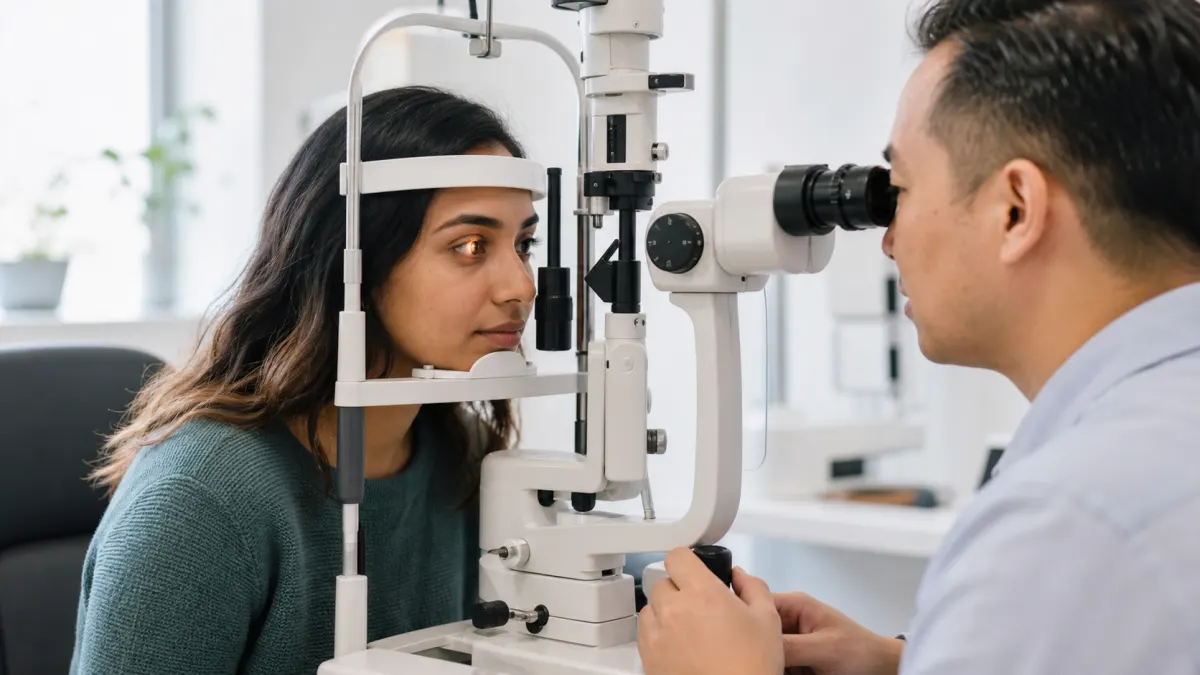
During a fitting, the optometrist observes orientation marks on the trial lens with a slit-lamp microscope. Those tiny marks are not visible during ordinary wear, but they show how the lens has rotated. The final ordered axis can be adjusted according to that observed behaviour rather than guessed from the glasses prescription alone.
A contact lens prescription is different from a glasses prescription
Glasses sit several millimetres in front of the eyes. Contact lenses rest directly on the tear film over the cornea. That change in position can affect the power needed, particularly for stronger prescriptions.
A contact lens prescription also identifies the fitted lens parameters and design. Base curve and diameter influence how the lens relates to the eye. Material affects oxygen transmission, surface wetting, handling, and comfort. For toric lenses, cylinder and axis availability vary by design. Replacement schedule and approved wear instructions matter too.
Two boxes that display similar powers are not automatically interchangeable. A different brand may fit, move, rotate, or dry differently. Substituting a lens without evaluation can reduce vision and comfort or create an unhealthy fit.
Online power calculators and old box labels cannot evaluate the cornea, tear film, eyelids, or lens movement. Even an experienced wearer should have a current contact lens assessment before changing designs or returning to lenses after a long break.
The eye-health examination comes first
Before placing a trial lens, the optometrist needs to know whether the eye surface is healthy enough for contact lens wear. The examination may assess the cornea, conjunctiva, eyelids, tear film, pupil, prescription, and internal eye health. Previous infection, injury, surgery, allergy, dry eye, and medication use are relevant.
Contact lenses reduce some oxygen reaching the cornea and can change the eye-surface environment. A lens that looks clear and feels acceptable for a few minutes may still be unsuitable if it fits too tightly, moves excessively, or interacts poorly with an existing condition.
Tell your optometrist about redness, recurring styes, seasonal allergy, dry eye, autoimmune disease, diabetes, past corneal problems, and any history of sleeping or swimming in lenses. The purpose is not to disqualify you. It is to choose a safer design and care plan—or treat an eye-surface problem before starting.
If you arrive wearing current contacts, the clinic may ask how long they have been in. In some situations you may be asked to leave certain lenses out before measurements so the cornea can return toward its natural shape. Follow the specific instructions given for your appointment.
Measurements and the first trial lens
The fitting begins with an accurate refraction and measurements of the eye. Corneal curvature provides information about the shape of the front surface. Additional mapping or imaging may be recommended for high or irregular astigmatism, previous surgery, keratoconus, or another corneal concern.
The optometrist selects an initial trial lens using the prescription, measurements, available parameters, eye health, and wearing goals. The lens is placed on the eye and allowed time to settle. Immediate vision matters, but it is only one part of the evaluation.
With the slit lamp, the optometrist assesses centration, coverage, movement with blinking and eye movement, edge relationship, surface wetting, and rotation. A lens that barely moves may feel fine at first but exchange tears poorly. A lens that moves too much may cause awareness, inconsistent vision, or irritation.
The orientation of a toric lens is recorded after it settles. If it rotates consistently, the prescription axis can sometimes be compensated. If it swings unpredictably, another design may be needed. Stability is more important than whether the lens looks perfectly upright.
“Which is better?” with a lens already on the eye
After the fit is assessed, the optometrist may perform an over-refraction. This means comparing additional lens powers while the trial contact lens is on your eye. It helps refine clarity and distinguish a residual prescription error from unstable rotation or an eye-surface problem.
Toric fitting often requires balancing small compromises. The exact cylinder or axis from the glasses prescription may not be manufactured in every soft lens. The optometrist chooses the available parameters and design expected to give the most useful result, then verifies the vision on the eye.
Both eyes should also work comfortably together. The sharpest isolated letter in one eye is not the only outcome. Real-world distance, screens, near tasks, depth, night vision, and visual balance can influence the final choice.
If presbyopia is also present, options may include multifocal toric lenses, modified monovision, or distance contacts with reading glasses. These approaches require discussion of priorities because maximizing one distance can affect another.
Why the first lens is sometimes not the final lens
A trial lens is a starting point, not a failure-proof product. The lens may need a power adjustment, a different axis, another base curve or diameter where choices exist, a different stabilization design, or another material.
What feels comfortable in the examination room may dry after a full workday. Vision that seems stable while sitting still may fluctuate during sports or a long commute. A lens can perform differently in heated winter air, air conditioning, or during prolonged screen use.
Follow-up appointments allow the optometrist to examine the lens after realistic wear and check the cornea after removal when appropriate. Bring specific observations: which eye blurs, whether blinking clears it, what time symptoms start, how long you wore the lens, and what activity was difficult.
Do not change several factors at once without guidance. Switching solution, extending wear time, using unapproved drops, and trying a different lens on the same day makes the response harder to interpret.
Soft toric lenses and replacement schedules
Soft toric lenses are available in daily disposable and planned-replacement formats, with the exact prescription range varying by product. A daily disposable lens is worn once and discarded. It can simplify care and provide a fresh surface each day, which some people find helpful for deposits, allergy, travel, or occasional wear.
Planned-replacement lenses are cleaned, disinfected, stored, and replaced on the schedule prescribed. They may offer different parameter ranges or economics for frequent wear, but safe use depends on consistent care. The replacement interval refers to calendar time after opening, not the number of days you happened to wear the lens.
Do not stretch a daily lens into a second day or keep a planned-replacement lens longer because it still looks clear. Microscopic deposits, surface changes, and contamination are not reliably judged by appearance. Follow the specific schedule for the fitted product.
The most expensive lens is not automatically the best, and the lens with the longest advertised wear is not automatically the healthiest choice for your eyes. Fit, material, prescription availability, wearing pattern, and care habits all belong in the decision.
Rigid and specialty options
Soft toric lenses are not the only way to correct astigmatism. A rigid gas-permeable lens holds its optical shape on the eye. The tear layer between the rigid lens and the cornea can neutralize some corneal astigmatism, often providing crisp vision. Adaptation and lens awareness differ from soft lenses, and fitting is more individualized.
Scleral lenses are larger rigid lenses that rest on the white part of the eye and vault over the cornea with a fluid reservoir. They may be considered for irregular corneas, keratoconus, severe ocular-surface disease, or other specialized needs. They require precise fitting, application with preservative-free filling solution as directed, and careful follow-up.
Hybrid and custom soft designs may be possibilities in selected cases. Availability, suitability, and cost vary. A person with high or irregular astigmatism should not assume that failing one standard soft toric lens means all contact lens options have failed.
Specialty lenses are not automatically necessary for ordinary astigmatism. The optometrist should explain why a design is recommended, what it aims to improve, and what care and follow-up it requires.
Learning insertion and removal
Safe handling is part of the fitting. New wearers should learn to wash and dry hands, identify whether a soft lens is inside out, apply it without damaging the eye, remove it safely, and follow the prescribed cleaning routine.
Short fingernails help during the learning stage, but technique matters more than forcing the eyelids. Work over a clean, dry surface and avoid a sink full of water. If a lens folds or falls, follow the instructions for that lens type rather than putting it directly back on the eye.
It may take several attempts to become confident. Rushing can lead to dropped lenses, poked eyes, or frustration. A supervised teaching appointment allows the clinic to see whether you can handle the lens safely before taking trials home.
Do not use saliva to wet a lens. Do not rinse contacts or cases with tap, bottled, distilled, lake, or pool water. Water can expose the eye to organisms that cause severe corneal infection and can also change the shape of a soft lens.
Contact lens care is part of the prescription
For reusable lenses, use the exact type of disinfecting system recommended for the lens and your eyes. Saline alone does not disinfect. Use fresh solution each time, rub and rinse when directed, and never “top off” old liquid in the case.
Clean the case with fresh disinfecting solution, allow it to air-dry in the recommended position, and replace it regularly. Keep the bottle tip from touching hands, lenses, the case, or other surfaces. Do not transfer solution into a smaller unlabelled container.
Hydrogen-peroxide systems require the supplied neutralizing case and the full neutralization time. Putting unneutralized peroxide directly in the eye causes intense pain and can injure the surface. Use only the system and steps you were taught.
Carry current backup glasses. If a lens becomes uncomfortable or vision changes, you need a safe alternative instead of continuing to wear it through work or driving.
Sleeping, showering, and swimming
Avoid sleeping in contact lenses unless the exact lens and wearing plan have been specifically prescribed for overnight wear. Even when a product is approved for extended wear, sleeping in lenses adds risk and should be discussed with the optometrist based on your eyes and needs.
Remove lenses before showering, swimming, or using a hot tub. Goggles over contacts do not guarantee that water will stay out. If you need clear vision for swimming, ask about prescription goggles or other safer strategies.
If water touches a lens, remove it as soon as you can safely do so. Daily disposable lenses should be discarded. Reusable lenses may need cleaning and disinfection before reuse according to professional and product instructions. Contact the clinic if the eye becomes painful, red, light-sensitive, or blurry.
These rules apply even if you have worn lenses around water many times without a problem. Infection risk does not become harmless through familiarity.
What fluctuating toric-lens vision can mean
Vision that blurs immediately after a blink and then clears may indicate lens rotation or movement. Vision that clears with a blink and then gradually hazes may point toward tear-film breakup or lens-surface drying. Constant blur may come from residual prescription, poor orientation, lens fit, deposits, or an unrelated eye problem.
Record the pattern rather than repeatedly rubbing or reseating the lens. Note whether it affects one eye, a particular distance, late-day wear, screens, or night driving. The optometrist can compare your description with slit-lamp findings and over-refraction.
Rewetting drops may help some wearers, but use only products compatible with contact lenses and recommended for your situation. Drops that “get the red out” are not a substitute for assessing a red or uncomfortable contact-lens eye.
If vision is not reliable enough for driving, remove the lenses and use suitable glasses. A toric lens that occasionally rotates cannot be made safe by squinting through the blur.
When to remove the lenses and call
Remove contact lenses promptly if you develop pain, significant redness, light sensitivity, sudden blur, unusual watering, discharge, or the sensation that something is stuck in the eye. Do not put the lens back in to see whether the symptom improves.
Contact the clinic for direction and bring the lenses, case, and solutions if asked. Do not self-treat with leftover antibiotic, steroid, or someone else’s drops. Steroid drops in particular can worsen certain infections when used without proper diagnosis.
Seek urgent medical attention for severe symptoms, chemical exposure, trauma, or sudden vision loss. Contact lens complications can progress quickly, and a painful red eye deserves professional assessment.
Mild awareness during early adaptation may be expected with some designs, especially rigid lenses, but worsening pain is not normal adaptation. The fitting team should explain what sensations are expected and which require stopping wear.
Contact lens fittings for astigmatism in North York
A successful astigmatism fitting combines optics, eye health, and real life. The lens must correct the right power in the right orientation, remain stable with blinking, move enough to support the eye surface, and stay comfortable for the intended wearing time. That result may come from the first trial, or it may require a deliberate adjustment.
Optima Eye Care provides contact lens exams and fittings in North York for new and experienced wearers, including patients with astigmatism, presbyopia, dry-eye concerns, and changing lens comfort. We evaluate the lens on the eye, teach safe handling, and use follow-up to confirm that the result works beyond the examination room.
If previous contacts rotated, dried out, blurred at night, or never felt quite right, bring the lens details and your current glasses to an assessment. Request an appointment to discuss whether a soft toric, daily disposable, planned-replacement, rigid, or specialty option fits your prescription and goals. Astigmatism may make the fitting more precise, but it does not mean you have to stop asking for clear, comfortable contact lens vision.