

Eye Care Resources
Blurry Vision in North York: Common Causes and When to Book an Eye Exam
February 12, 2026
Blurry vision is one of the most common reasons people book an eye exam, but the words can describe many different experiences. One person may struggle to read a street sign. Another may hold a phone farther away. Someone else may see clearly after blinking, then notice the image become hazy again. A sudden dark or blurred area in one eye is a very different concern from a glasses prescription that has gradually become less effective.
That is why an optometrist will ask more than, “Is your vision blurry?” The useful questions are where, when, how quickly, and in which eye the change began. Does it affect distance, near work, or both? Is it constant or intermittent? Does blinking help? Is there pain, redness, light sensitivity, double vision, flashes, floaters, headache, or another new symptom?
For patients experiencing blurry vision in North York, the safest next step depends on that pattern. Some causes are common and easily corrected. Others require prompt assessment. A comprehensive eye exam can measure your prescription, evaluate how the eyes focus and work together, and check the health of the eye from front to back.
What people mean by blurry vision
True blur usually means that details no longer appear sharp. Edges may look soft, small print may merge together, or faces may be harder to recognize at a distance. However, people also use “blurry” to describe ghost images, glare, halos, a film over the eyes, missing areas, distortion, double vision, or difficulty focusing. Each description can point the examination in a different direction.
Try covering one eye and then the other without pressing on the eyelid. If the problem is present in only one eye, tell the clinic. If the image clears when either eye is covered but looks doubled with both eyes open, that distinction is also important. Do not repeatedly test or delay care when the change is sudden or accompanied by warning signs; call for professional guidance.
The timing matters just as much. Gradual distance blur over several months often follows a different path from vision that disappears or changes over minutes. Fluctuating blur after computer work may involve the tear film or focusing system, while blur that is most noticeable in dim light may bring up prescription, pupil, lens, or retinal considerations.
A changing glasses prescription
Refractive error is a common reason vision becomes blurry. Nearsightedness makes distant objects look less clear. Farsightedness can affect near comfort and, depending on age and degree, distance vision as well. Astigmatism may create blur, shadowing, or streaks around lights at several distances. Presbyopia is the age-related loss of near focusing ability that generally becomes noticeable during the forties.
Prescriptions can change gradually, and people are often good at compensating. You may squint to read road signs, move closer to a television, enlarge your phone text, or choose the seat nearest a presentation screen. Because the change is slow, it can start to feel normal.
An updated prescription may restore clarity, but the correct lens is not determined by a quick guess or an online test alone. Your optometrist compares your responses, checks how the eyes work together, considers the distances you use, and makes sure reduced vision is not being caused by an eye-health problem. If one eye cannot be sharpened as expected with lenses, that finding deserves further investigation.
Blur that improves after blinking
If vision becomes clearer for a moment after a complete blink, the tear film may be unstable. Tears form a smooth optical surface over the cornea. When that layer breaks up too quickly, details can fluctuate even when your glasses prescription is accurate.
Dry eye may cause burning, grittiness, watering, redness, tired eyelids, or sensitivity to moving air, but some patients mainly notice changing clarity. Long screen sessions, incomplete blinking, indoor heating, air conditioning, medication, eyelid-gland problems, and contact lens wear can all contribute.
Using lubricating drops may help, but not every bottle serves the same purpose. Drops intended to reduce redness are not necessarily dry-eye treatment, and frequent use of preserved products may not be suitable for every patient. An eye exam can evaluate the tear film, eyelids, cornea, and blink pattern so that care matches the likely cause rather than the label “dryness.”
Contact lenses and changing clarity
Contact lens vision can fluctuate when a lens becomes dry, moves excessively, fits poorly, is inside out, accumulates deposits, or is worn beyond its replacement schedule. Astigmatism-correcting lenses may rotate, causing temporary blur that changes after a blink. A prescription that works in glasses may also need to be adjusted appropriately for contact lenses.
Do not continue wearing a lens that causes pain, pronounced redness, light sensitivity, discharge, or a sudden reduction in vision. Remove it with clean hands and contact an eye care professional. Contact lens wear raises the importance of promptly assessing certain corneal infections and inflammatory problems.
Never rinse lenses or cases with tap water, and do not use saliva to wet a lens. Wear and replace contacts according to professional instructions. If lenses that were once comfortable have become unreliable, a contact lens exam can check vision, fit, movement, eye-surface health, cleaning habits, and whether another lens design would be more appropriate.
Near blur after age 40
Adults often first notice presbyopia when a menu, label, or phone seems clearer at arm’s length. The natural lens inside the eye becomes less flexible with time, reducing the ability to focus up close. Dim lighting makes the problem more noticeable because small print has less contrast and the visual system has fewer helpful cues.
Presbyopia is normal, but not every near-vision complaint should automatically be blamed on age. An uncorrected distance prescription, dry eye, medication, diabetes, cataract, or eye-coordination concern can also affect reading. A complete exam helps separate these possibilities.
Reading glasses may be enough for some people. Others prefer progressive lenses, bifocals, occupational lenses, contact lenses, or different glasses for different tasks. The right choice depends on your distance prescription, working distances, screen setup, hobbies, driving needs, and comfort with adaptation.
Blurry vision in children
Children may not report blur because they assume everyone sees the same way. A child who cannot see the classroom board may move closer, copy from a neighbour, squint, lose interest, or appear distracted. A child with a near-vision or eye-coordination problem may avoid reading, lose their place, rub their eyes, or complain that schoolwork is tiring.
Parents should watch for sitting close to screens, holding books unusually near, closing one eye, frequent headaches, difficulty catching a ball, or a change in school confidence. A school vision screening can identify some concerns, but it does not replace a comprehensive children’s eye exam.
Myopia, or nearsightedness, often develops during the school years and may progress as a child grows. Updating glasses restores clarity, while a separate myopia-management discussion considers whether strategies to slow progression may be appropriate. Early identification gives families more time to understand the options.
Cataracts and gradual haze
A cataract is a clouding of the natural lens inside the eye. It can cause gradual blur, glare, halos, reduced contrast, faded colour, frequent prescription changes, or difficulty driving at night. Cataracts are more common with age, but age is not the only factor associated with their development.
Early cataracts may not require surgery. An updated prescription, improved lighting, or glare management may provide useful vision for a period of time. When cataracts interfere with activities that matter, an optometrist can explain the findings and discuss referral for a surgical assessment.
Because cataract symptoms overlap with other problems, self-diagnosis is unreliable. The exam should also assess the retina, optic nerve, cornea, eye pressure, and other structures that can affect clarity.
Blood sugar and vision changes
Changes in blood glucose can temporarily affect how the eye focuses, causing the prescription and vision to fluctuate. Diabetes can also damage blood vessels in the retina, sometimes before a person notices a change in sight. This is why people with diabetes need eye-health monitoring even when their vision feels stable.
If your blood sugar has been changing and your glasses suddenly seem wrong, tell both your optometrist and the health professional managing your diabetes. A prescription measured during a period of significant fluctuation may not remain stable. Do not assume that all blur is temporary, especially if it affects one eye or is accompanied by spots, shadows, or missing vision.
A diabetic eye exam is focused not only on how clearly you read but also on detecting retinal changes and coordinating care when needed.
Migraine and visual symptoms
Some migraines involve temporary visual phenomena such as shimmering patterns, zigzags, blind spots, or distortion. These symptoms may develop gradually and resolve, sometimes before a headache and sometimes without one. However, a first episode, an unusual pattern, or a sudden visual loss should not be labelled as migraine without appropriate medical guidance.
Retinal and neurological problems can produce symptoms that patients confuse with aura. If you are uncertain, especially when the symptom is new, affects one eye, or includes weakness, numbness, speech difficulty, or a severe headache, seek urgent medical assessment.
An eye exam can help rule out ocular causes of blur, but headache and neurological symptoms may require your family doctor, an emergency department, or another medical professional. The right referral is part of responsible eye care.
Other health and medication factors
Vision can change in association with pregnancy, thyroid disease, autoimmune conditions, high blood pressure, corneal disorders, retinal disease, inflammation, and other health concerns. Some medications can affect focusing, tear production, pupil size, eye pressure, or visual perception.
Do not stop a prescribed medication because you suspect it is affecting your eyes. Bring an up-to-date medication list to your appointment, including over-the-counter products and supplements. Your optometrist can consider whether the timing of a visual change fits a known effect and communicate with the prescribing professional when appropriate.
The exam may also reveal that the eyes are healthy and the prescription is stable. That result does not make the symptom unimportant. It helps narrow the possibilities and may indicate that a medical evaluation outside eye care is the next step.
When blurry vision is urgent
Sudden vision loss or a rapid, unexplained change should be treated differently from a gradual prescription shift. Seek prompt guidance if blur begins suddenly, particularly in one eye. Urgent warning signs include:
- a curtain, veil, shadow, or missing area in the vision;
- a sudden shower of new floaters or repeated flashes of light;
- significant eye pain, redness, light sensitivity, nausea, or coloured halos;
- sudden double vision or difficulty moving an eye;
- vision change after an injury or chemical exposure;
- a new severe headache, weakness, numbness, facial droop, confusion, or speech difficulty;
- a painful red eye in a contact lens wearer; or
- an abrupt central blur or distortion.
This list is not exhaustive. Call Optima Eye Care for direction when an eye symptom is concerning, and call emergency services for signs of stroke, major trauma, or another medical emergency. Waiting to see whether sudden loss improves can cost valuable time.
What to notice before your appointment
You do not need to diagnose the problem yourself, but a few observations can make the history more useful. Note when the change began, whether the onset was sudden or gradual, and whether one eye or both eyes are affected. Pay attention to the distance at which blur occurs and whether blinking, brighter light, rest, or your glasses changes it.
Bring every pair of glasses you regularly use, your contact lens information, medication list, and relevant health history. Mention recent injuries, infections, blood-sugar changes, new medications, pregnancy, headaches, and family history of eye disease. If a particular workstation or hobby triggers the problem, measure the approximate viewing distance or take a simple photo of the setup.
Avoid driving yourself if you do not feel that your vision is safe. Ask whether your appointment may involve dilating drops, since those can temporarily affect near vision and light sensitivity.
What happens during a blurry-vision eye exam?
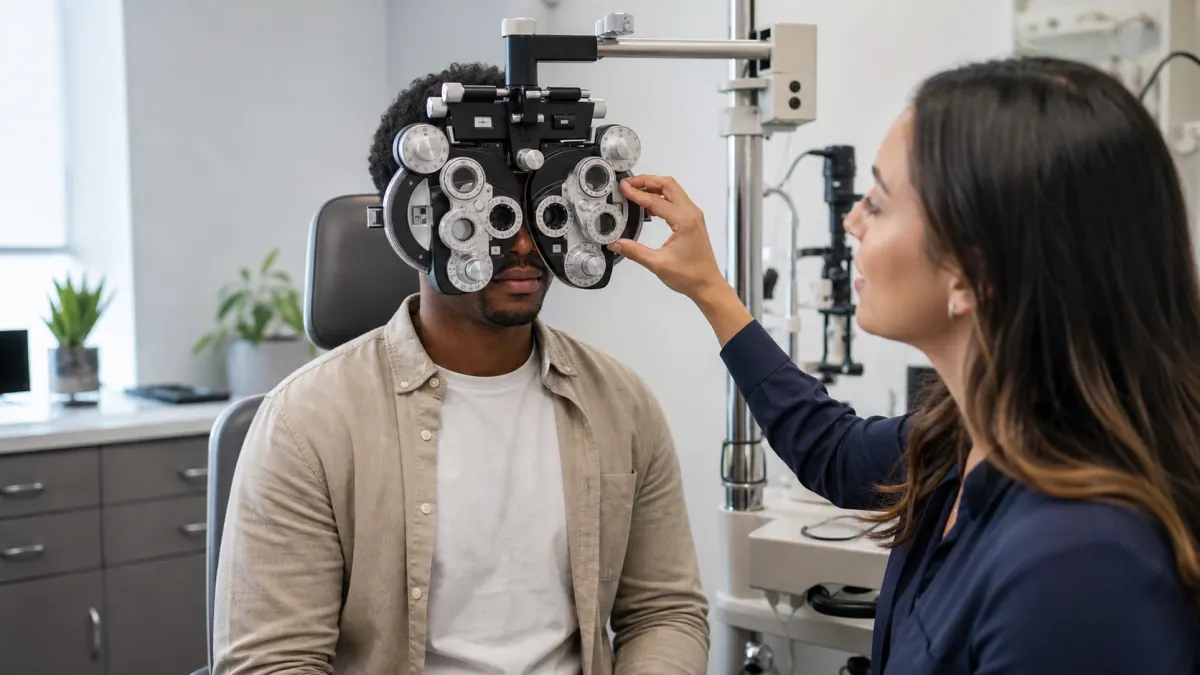
The appointment usually begins with a detailed history and measurements of vision in each eye. Refraction determines whether lenses improve clarity. Depending on your symptoms, the optometrist may assess pupils, eye movements, alignment, focusing, peripheral vision, colour vision, the cornea and tear film, eye pressure, the natural lens, retina, macula, and optic nerve.
Additional imaging or dilation may be recommended based on the findings and your health history. The goal is not simply to produce a glasses prescription. It is to explain why the vision changed, identify concerns that require treatment or referral, and establish an appropriate follow-up plan.
Sometimes there is more than one contributor. A patient may have a small prescription change plus dry eye, or early cataract plus glare from an old lens coating. Addressing each factor can provide a better result than expecting one new pair of glasses to solve everything.
Blurry vision care in North York
Blur is your visual system’s way of telling you that something has changed, but it does not identify the cause on its own. Gradual distance blur, tired near vision, fluctuating contact lenses, and sudden loss do not belong in the same category. The pattern determines how quickly you should be seen and what the exam needs to investigate.
Optima Eye Care provides comprehensive eye exams and urgent eye-care guidance for patients in North York. If your vision is no longer reliable for reading, screens, school, work, or driving, request an appointment. If the change was sudden or includes pain, flashes, floaters, a shadow, double vision, or neurological symptoms, call for immediate direction rather than booking a distant routine visit online.
Clearer vision often begins with a new prescription or targeted eye-surface care. Just as importantly, an exam can identify when blur is a sign that the eyes—or your broader health—need closer attention.