

Eye Care Resources
Amblyopia in North York: Understanding Lazy Eye and Supporting Your Child's Treatment
September 15, 2026
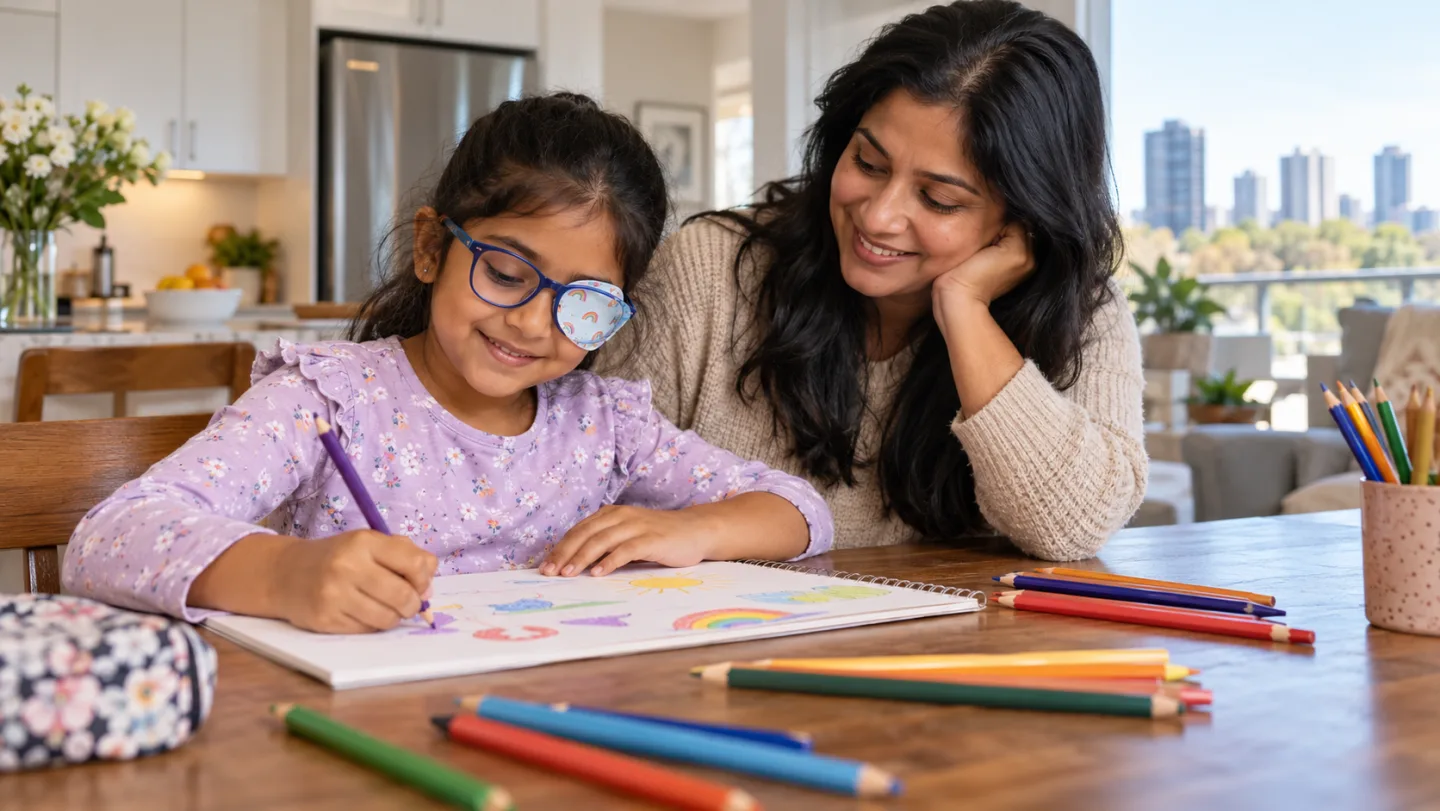
A child can recognize a favourite cartoon, spot a friend across the playground, and still have significantly weaker vision in one eye. That surprises many parents. When both eyes are open, the better-seeing eye may do enough of the work that the child has no reason to complain. They may assume everyone sees the way they do.
Amblyopia, sometimes called lazy eye, develops during childhood when visual development does not progress normally in one or occasionally both eyes. The term describes a vision problem, not a child’s effort or attention. Understanding amblyopia in North York begins with separating what a child appears able to do from what each eye can actually see on an appropriate examination.
The National Eye Institute’s amblyopia overview explains why early identification matters and why the stronger eye can conceal difficulty in the other. A child does not need to read letters confidently, complain of blur, or struggle at school before an eye-care professional can assess their vision.
Amblyopia and an eye turn are different findings
Parents often use “lazy eye” to describe an eye that drifts inward or outward. Eye misalignment is called strabismus. Amblyopia refers to reduced vision caused by disrupted visual development. The two can occur together, but they are not interchangeable.
A child may have eyes that look straight and still have amblyopia. Conversely, a child with an eye turn may have similar measured vision in each eye. This is why a photograph, a family member’s observation, or a quick check of eye appearance cannot settle the diagnosis.
At the appointment, ask the clinician to explain both findings separately: How well does each eye see? Are the eyes aligned? Can they work together? What is affecting the quality of the image reaching each eye? Those answers make the purpose of glasses, patching, or a referral much easier to understand.
Why an unequal prescription can be easy to miss
One possible cause is a substantial prescription difference between the eyes, known as anisometropia. If one eye receives a consistently less clear image during development, the brain may favour the clearer input. The child does not necessarily experience the blur as a new symptom because there may never have been a sharper comparison.
The American Association for Pediatric Ophthalmology and Strabismus explains anisometropia and its connection to amblyopia. Glasses may be an important first part of treatment because they improve the optical information available to the eyes.
For families, the practical lesson is that “my child can see the television” is not a complete vision test. Neither is comparing siblings or asking a child to read something with both eyes open. Formal testing measures each eye separately and considers age, cooperation, prescription, and eye health together.
What to expect at a children’s eye examination
A child’s examination is adapted to their age and communication skills. Pictures, matching tasks, or observations of visual behaviour can be used when a standard letter chart is unsuitable. The clinician may assess eye alignment, focusing, movement, and the health of the eyes as well as visual acuity.
Drops may be recommended to relax focusing and help measure the prescription accurately. Ask what the drops are for, how long the effects are likely to last, and whether your plans for the rest of the day need adjusting. If your child is anxious about drops, mentioning that when booking gives the team a chance to prepare.
Bring existing glasses, previous results, relevant health information, and any notes from another eye-care provider. Tell the clinic about prematurity, developmental needs, or a family history of childhood eye problems. A short list is more useful than trying to remember everything while helping a tired child through a new experience.
Glasses can be treatment, even before a patch is discussed
Families sometimes expect patching immediately and worry that a glasses-first plan is not doing enough. In suitable cases, correcting the prescription and allowing time to measure the response is an important treatment step. The plan depends on the cause and severity of the vision difference.
Good frame fit matters. Glasses that slide down, press behind the ears, or sit crooked are harder to wear consistently. A child who repeatedly removes them may be communicating discomfort, frustration, or difficulty adapting rather than simply refusing to cooperate.
The AAPOS guide to glasses for children describes the roles spectacles can play in developing vision. At home, make glasses easy to find, clean them gently, and keep the case in a predictable place. Ask the clinic what to do if a frame breaks, because several weeks without the prescribed correction can interrupt the intended routine.
Patching should follow a specific prescription
When patching is recommended, the better-seeing eye is covered so the weaker eye has an opportunity to be used. The number of hours and the review schedule depend on the child. More patching is not automatically better, and choosing an eye or schedule yourself can be harmful.
Before starting, have the instructions written clearly: which eye, how long each day, whether glasses stay on, and when the next assessment occurs. Make sure every caregiver has the same version. A note on the fridge or in a shared calendar can prevent accidental confusion between households or after-school arrangements.
The AAPOS amblyopia resource outlines patching and other treatment options. If the plan is difficult to carry out, contact the treating team rather than hiding missed sessions or doubling the time the following day. An accurate picture of the routine helps them make a realistic adjustment.
Building a routine that does not take over family life
Treatment tends to go more smoothly when it has a predictable place in the day. Choose a period that fits the prescribed schedule and your child’s energy. A rushed morning may be less manageable than a calm period after a snack. For another family, evenings may be the hardest time, and a morning routine may work better.
Offer small choices within the plan: which activity to do, where to sit, or which approved patch design to use. The child can have some control without being asked to decide whether treatment happens at all. Activities should be suitable for what the child can see and what their clinician recommends.
Avoid turning every session into a test of performance. A puzzle does not need to be finished, and a drawing does not need to be neat. The goal is following the prescribed treatment, not proving that the child can complete a difficult task while their easier eye is covered.
Comfort, peeking, and honest troubleshooting
A patch needs to work as intended. If a child can look around it, the weaker eye may not receive the intended opportunity. Skin irritation, uncomfortable adhesive, or a poorly fitting cover can also make the routine unnecessarily difficult.
The AAPOS patching tips for parents discuss fit and different patch arrangements. Ask your provider to demonstrate the recommended option on your child rather than assuming every product on a shelf works the same way.
Keep troubleshooting specific. Instead of “patching never works,” describe what happens: the edge lifts after twenty minutes, the skin becomes red, the child cannot manage a particular activity, or the glasses sit differently with the patch. Photographs of the fit or a brief record of the difficulty may help the clinic suggest a practical solution. Do not apply creams near the eye or alter a patching system without checking suitability first.
What if drops are recommended instead?
Some children are treated with prescribed drops that reduce the stronger eye’s advantage for certain tasks. This is a medical treatment with a particular dose, schedule, and monitoring plan. It is not the same as using an ordinary lubricating drop or buying a product marketed for tired eyes.
Ask the prescriber to demonstrate administration, explain expected effects, and identify symptoms that require a call. Keep the bottle out of children’s reach and make sure other caregivers understand exactly which eye receives the medication. If a dose is missed, follow the instructions you were given or contact the clinic; do not invent a catch-up schedule.
Families should also understand how the treatment fits with schoolwork, outdoor light, and other medicines. Bringing the actual bottle to a follow-up visit can be helpful when there is uncertainty about the product or directions. Never share a sibling’s eye drops, even if both children have been told they have amblyopia.
School, childcare, and conversations with other children
A short explanation to teachers or childcare staff can prevent unnecessary confusion. Describe the prescribed routine, whether any part takes place during school, and whom to contact if glasses are damaged or the child is uncomfortable. Ask for discretion rather than making the child’s treatment a classroom event.
Prepare a simple response for curious classmates. A child might say, “My patch helps my other eye practise seeing.” They do not owe anyone a detailed medical explanation. If teasing develops, address it with the school rather than asking the child to tolerate it as part of treatment.
Keep the distinction between vision and learning clear. Better visual access may make some tasks easier, but amblyopia treatment is not a promise to resolve every reading or attention difficulty. If educational concerns continue, discuss them with the appropriate school and healthcare professionals alongside the eye-care plan.
Progress is measured at visits, not guessed at home
Some improvements are not obvious in everyday behaviour. A child may still look equally capable with both eyes open even while the weaker eye’s measured vision changes. Conversely, cheerful patch wear does not prove that the treatment is complete.
Follow-up allows the clinician to recheck each eye, review the prescription, and decide whether the current approach should continue. Do not stop treatment simply because a child seems to be doing well, and do not assume a birthday makes assessment pointless. Older children may still benefit from evaluation and an individualized discussion, although earlier treatment is generally preferable.
Bring a realistic account of wear time and any barriers. A simple weekly note is enough; you do not need an elaborate spreadsheet. The most valuable information is honest and specific. “We managed most weekdays but struggled during the weekend tournament” is more useful than a perfect-looking record that does not reflect what happened.
When to seek help sooner
Amblyopia is a developmental condition. Sudden vision loss, a newly painful eye, an abrupt eye turn, or new double vision should not automatically be attributed to an established amblyopia diagnosis. Contact an eye-care professional promptly for new symptoms, and seek emergency care for severe symptoms or associated neurological changes.
Also contact the treating team when the planned routine is becoming unmanageable, a child repeatedly loses or breaks glasses, or you are unsure whether instructions have changed. Asking early is often easier than trying to reconstruct several months of interrupted treatment at the next appointment.
A practical first step for families in North York
If your child has not had an appropriate eye assessment, or you have been told that one eye sees less clearly, book a children’s eye examination with Optima Eye Care. Bring previous prescriptions and treatment instructions so the team can understand what has already been tried and whether specialist involvement is needed.
The clinic is located at 105 Gordon Baker Road, Suite 101, in North York. Call (416) 497-3705 with questions about arranging the visit. You can also read our guide to children’s vision and learning for related observations to discuss.
The most helpful approach is steady rather than dramatic: identify the problem, understand the purpose of each treatment, make the daily plan workable, and return for measurement. A child does not need to notice a problem before their developing vision deserves attention.